They say a good story is all in the tee-up, which feels appropriate, since mine starts on the 17th hole of a golf course I played last Sunday.
For many years, I’ve played two annual rounds with three good friends: a spring charity tournament followed by a fall outing at a new course we choose each year.
Last week, the guy tasked with booking next Saturday’s fall classic admitted over email that he had procrastinated until our target course had sold out.
Another guy suggested we try Nobleton Lakes Golf Course instead, as they can usually accommodate a late booking.
So he agreed to book it, and I offered to arrange the post-round dinner at a nearby restaurant in Kleinburg owned by another good friend of mine.
Fast forward to Sunday. Walking up to the 17th tee, I asked my friend what tee time he’d snagged for our round the following weekend in Nobleton.
“I thought you were booking it?” he said.
“Me?” I snapped. “I’m booking the restaurant, not the golf!”
“Oh,” he shrugged. “I wondered why I hadn’t heard from you.”
Rolling my eyes, but still smiling, I muttered, “You had one job.”
Somewhat distracted, or at least that’s what I said after my shot, I stepped up to hit my drive and flared it wayward into the deep rough, while the rest of the group striped theirs right down the middle.
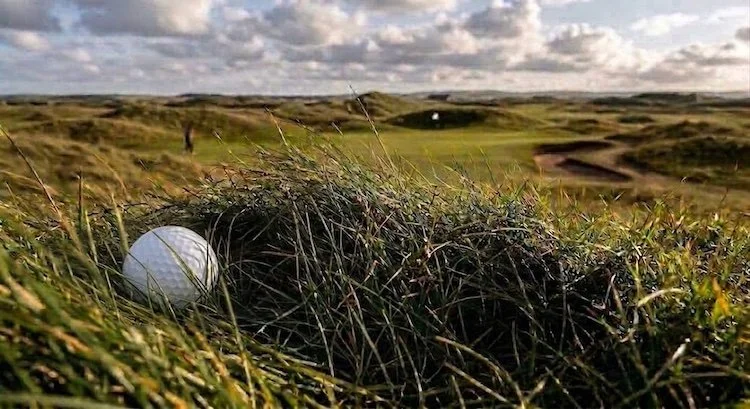
As they happily strolled up the fairway, I combed my way through the long grass until I stumbled upon two balls resting side by side.
“Find it?” they yelled from the fairway.
“I found two, actually!”
The first was indeed mine: a Titleist number 1 with my signature green dot. I picked up the second ball, another Titleist, and turned it over in disbelief. A bird logo was stamped on the side, and underneath it read: Nobleton Lakes Golf Club.
“Whose is the other one?” they called out.
As I stared at the cosmic, tailor-made coincidence sitting in my hand, I screamed, “You’ve got to be kidding me!”
I held it up, read the logo to them, and the fairway erupted: “Get the ‘bleep’ out of here!”
For years, I would wonder about events like these, always trying to figure out what they meant.
But lately, I’ve come to understand that while the word wonder means to try to know or understand, it also describes a feeling of surprise and admiration, with no explanation or understanding required. Simply awe.
Educator and writer Walt Streightiff once wrote: “There are no seven wonders of the world in the eyes of a child. There are seven million.”
A 1968 study found that 98% of 4- to 5-year-olds possess “genius-level” creative thinking, but that number plummets to just under 2% in adults.
Researchers concluded that traditional schooling and social conditioning drive this decline by teaching children that problems have only one right answer, ultimately diminishing their imagination.
In short, the wondering ends. Not the understanding part, but that feeling of awe. That feeling of wow.
Today, I share my story and leave it up to you, the reader, to arrive at whatever meaning you might find in it, if any at all.
Was it kismet that day, fate, a sign from the universe or just a fluke of nature? I guess it really depends on who you ask.
What I can say is that the perfect moment I experienced was ironically not to be found on the pristine short grass of the fairway, but in the long, unmanicured grass we call the rough.
Had I attained my desire to have my ball sitting beside everyone else’s, I might have won, but I also would have lost.
We all would have, actually. Instead, four grown men got to share a moment of wow, with the same sense of wonder a child might feel seeing a butterfly or bird for the very first time.
There seem to be many pieces to this puzzle we call life, and I’m starting to think many of our struggles stem from trying to answer each piece individually instead of lovingly collecting them and letting them fit together naturally, in their own time.
And in my experience, that connection rarely happens in my head.
So this time, I’m not going to kick this wondrous moment around in my little peanut trying to figure out what it all means.
I’ll just return it to where I think it belongs, in my heart, and let the mystery be.