
After reading my January newsletter, a friend of mine asked, “Why do you call it a ‘Subjective Perspective’ - isn’t your role as a coach to be objective?”
It’s a fair question, and one that I had pondered many times before deciding to go with subjective.
“I realized that claiming ‘complete objectivity’ is something that I could not in good conscience say,” I replied, adding, “Who could really?”
To be objective is to be a mirror, one with no past, no future, no emotion, and therefore no bias. Just the facts.
But can anyone honestly say they live that way?
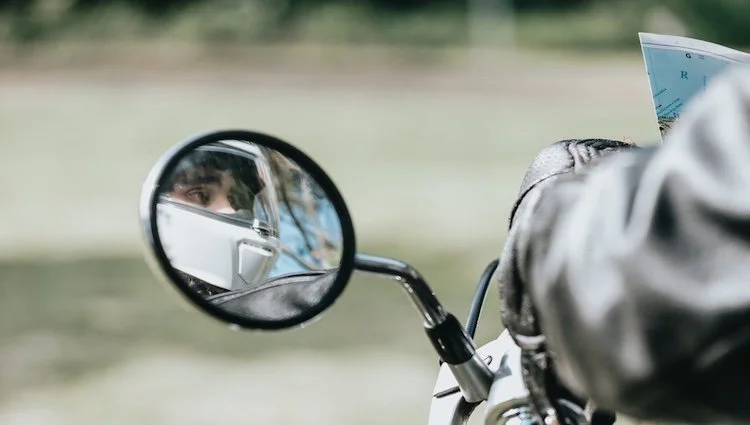
When I return home from a relaxing mid-summer night’s ride on my motorcycle, I spend the next half hour cleaning the ‘facts’ of that ride off of my helmet.
Seen through the lens of the other bugs, I’m a “high-speed maniac who came out of nowhere and took out Johnny and half his crew!”
Same event, different lens with no objective truth to be found.
The word objective can also mean: something that you plan to do or achieve.
Ironically, the moment we have an objective, we lose all objectivity.
Our goal becomes its own lens or filter, as everything we encounter is now categorized: it’s either an asset or a liability, a shortcut or a hindrance to what we want to achieve.
We are no longer observing reality as it is; we are measuring it against what we desire.
I’m not convinced that any of us can be completely objective in life. I am certain, however, that complete subjectivity is more than doable.
Examples of this can usually be found in social gatherings, in those somewhat tedious and often one-sided conversations that usually end with, “I’m going to get another drink, you want anything?”
And in the spirit of objectivity, I have also been known to be the recipient of that awkward question a few times, as well.
French author Anais Nin once wrote, “We don't see things as they are, we see them as we are.”
This is not only philosophy; it’s also physics.
One of the major tenets of quantum mechanics is that the act of observation actually changes the object being observed, meaning we don’t simply look at our lives; we interact with them.
This concept can also be found in many religions, too.
In Catholicism, Proverbs 23:7 states: “As a man thinketh in his heart, so is he.”
In Buddhism: “The root of suffering is attachment,” (ie, the self or subjectivity.)
In short, we don’t find meaning in the world; we project meaning into it.
“Reality,” as Einstein once said, “is merely an illusion, albeit a persistent one.”
So, is the deer crossing the road, or is the road crossing the forest?
It really depends on who you ask.
Our obstacles on the road of life often arise from being stuck in a particular point of view, from where we are to where we think we’re supposed to be.
Some would propose that the solution is to focus harder and create a stronger mindset.
But as I look back at some of our darker and more troubled times in history, much of the damage that ensued came from very set minds.
What unsticks us is remembering that the world we see is not viewed through a fixed aperture of facts, but rather a zoom lens of interpretation.
It is our ability to entertain in any situation that it is not always the result that needs to change, but our limited perception of it, and to see a bigger picture.
Paradoxically, what distorts that objectivity is our objective.
The solution is not to try to expand objectivity, but rather to temporarily suspend our own subjectivity long enough so that we are able to see a different landscape.
With less attachment comes less struggle.
We each decide if life is just something that is happening to us or if we are creating it.
Whichever lens we choose will ultimately determine the reality we experience.
